| George Finmore and Family | ||||||||||
|
Memorabilia
|
When George died in 1834, aged 75, he left a will that had been witnessed by three masters from Eton College. At the time of his death he had freehold property in both Clewer and nearby Bray. After disposal, the value of the estate was to be shared equally between his sons and daughters, although his son Henry had the option to inherit the property at Clewer so long as he paid a fair share to the rest of the family. His other effects were also to be shared between his children except for “the bed given to me by Mrs Hawtry and which I hereby give to my daughter Elizabeth.” Hawtrey was the name of the Headmaster at Eton College at the time.
St Martin in the Fields, Westminster
The reason for this close relationship with the college can be found in the census of 1841 where Henry Finmore’s occupation is given as Servant to the Headmaster. Ten years later he described himself as butler and had a house in Weston’s Yard, next to the headmaster’s house. However the headmaster was single, as were his two sisters who were staying with him, so it is unclear quite who was the donor of George's bed. Fortunately, working close to the headmaster brought Henry to the attention of Eton boys and he was remembered in their published memoirs, even rating an illustration in one. To see this and to learn something of his life at Eton look at the page for Henry Finmore. George and Catherine had eleven children between 1790 and 1810. The eldest son, William, took up his father's occupation and is probably the Thames fisherman featured in one chapter of a book entitled “Curiosities in Natural History”. The author, Francis T Buckland, described a fishing trip on the Thames at Windsor “in August last”. As the Preface is dated 30 November 1857 and George Finmore died in 1834, it seems likely that the fisherman described as an old man was William, who would have been nearly sixty when the book was written. The fisherman was only named once as Finmore, and thereafter was referred to as Charon: the aged ferryman of Greek mythology who takes the dead across the Styx. There are extracts from the book quoting the fisherman's opinions on a page for William Finmore.
Clewer Church from the Thames George Finmore's name appeared in an edition of the Berkshire Chronicle for Saturday, January 13th 1827. At the Berkshire Epiphany Sessions George gave evidence against A Towers who was found guilty of the theft of elm and deal boards, the property of George Finmore and Jonathan Griffin, of Clewer. The constable of Clewer told the Court he had “found withy poles, and the piece of a rudder of a boat, in the prisoner’s house. The withy boards had been sawed up and put under his bed.” Towers was to be "imprisoned for two calendar months to hard labour." It seems George and Jonathan were in business together, which might be explained by the contents of a will written in 1790 by Mary Griffin, Catherine's mother.
"Son in law" and "Daughter in law" indicate that Jonathan Griffin and Ann Simmonds were stepchildren of Mary Griffin. There is a record of a marriage by licence at Clewer for Ann Griffen and Henry Symonds on 25 August 1760. Ann was a minor, which would fit with the baptism of Ann Griffin on 24 August 1742 at Clewer. Her parents were Jonathan and Ann Griffin. It seems the young Ann waited until she had just turned eighteen before she married Henry. Mary Griffin died in 1811 and it appears that after Jonathan had inherited the “fishing boats and nets” he and his half-brother George Finmore went into partnership together.
The interior of St Martin in the Fields
Return to Cambridgeshire Burgesses page
| |||||||||
| Top of Page |  |
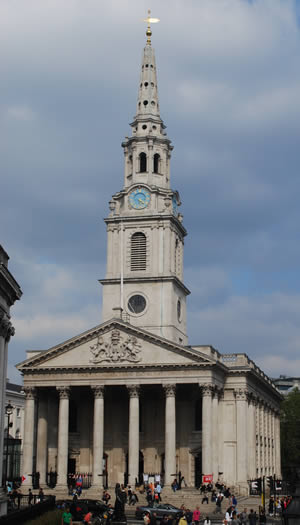 George Finmore married Catherine Griffin on 5 January 1791 at St Martin in the Fields Church, Westminster. A surprising venue perhaps, for a Thames fisherman from Clewer in Berkshire; but then the Finmore family has proved to be rather unusual in several respects.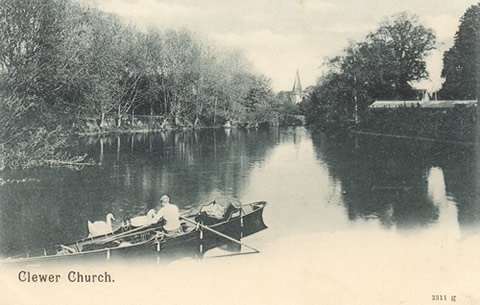
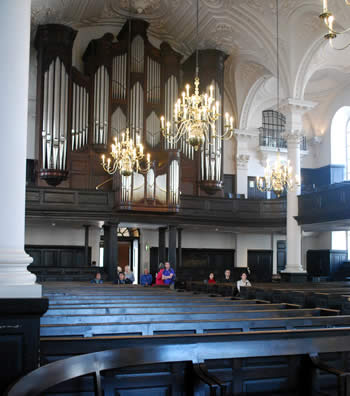 As well as asking friends in St Martin in the Fields to be the executors of her
will Mary had other connections to the parish. Her daughter Catherine was married there and Mary's own wedding had been celebrated in the church of St Martin in the Fields. Mary Houghton married Jonathan Griffin by licence on 20 February 1764. The licence itself reveals that both Mary and Jonathan were widowed which confirms the "in law" relationship in Mary's will but also means that Houghton was not her original maiden name.
As well as asking friends in St Martin in the Fields to be the executors of her
will Mary had other connections to the parish. Her daughter Catherine was married there and Mary's own wedding had been celebrated in the church of St Martin in the Fields. Mary Houghton married Jonathan Griffin by licence on 20 February 1764. The licence itself reveals that both Mary and Jonathan were widowed which confirms the "in law" relationship in Mary's will but also means that Houghton was not her original maiden name.